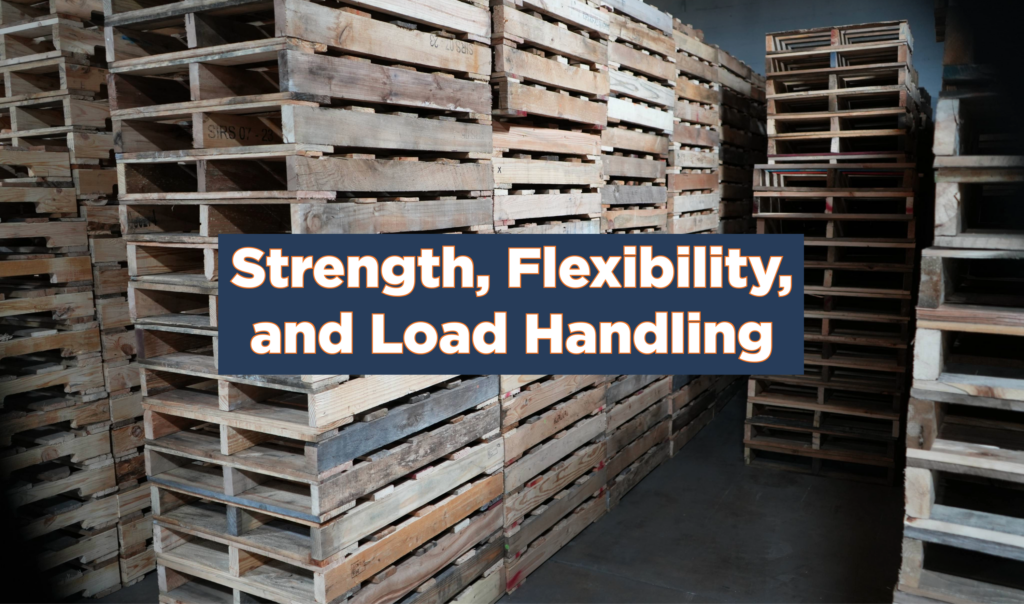
Manufacturing and industrial supply chains place heavy demands on pallets. Irregular loads, high weights, and rugged environments require pallets that can handle stress without excessive cost.
In 2026, wood pallets remain widely used in industrial logistics because of their strength, adaptability, and repairability.
Why manufacturing relies on wood pallets
Wood pallets perform well in industrial settings because they:
- Support heavy loads
- Accommodate custom sizes
- Tolerate rough handling
- Can be repaired onsite
This flexibility is critical in manufacturing environments where loads vary.
Load handling and pallet design
Industrial wood pallets are often designed with thicker deck boards, reinforced stringers, or block construction to support heavier products.
Matching pallet design to load requirements reduces breakage and improves safety.
Customization advantages
Unlike standardized packaging, wood pallets can be built to fit specific products. This reduces overhang, load shifting, and damage during transport.
Customization supports:
- Machinery transport
- Building materials
- Automotive components
Maintenance in industrial environments
Industrial settings are demanding. Pallet inspection and repair programs help maintain performance under repeated heavy use.
Facilities that maintain repair standards see fewer pallet failures and safer operations.
Real US industrial scenario
In metal fabrication facilities, pallets support dense, heavy materials. Wood pallets with reinforced construction provide cost-effective load support without requiring specialized platforms.
Final takeaway
Wood pallets remain essential in manufacturing and industrial logistics due to their strength and adaptability. In 2026, proper design and maintenance maximize their value.